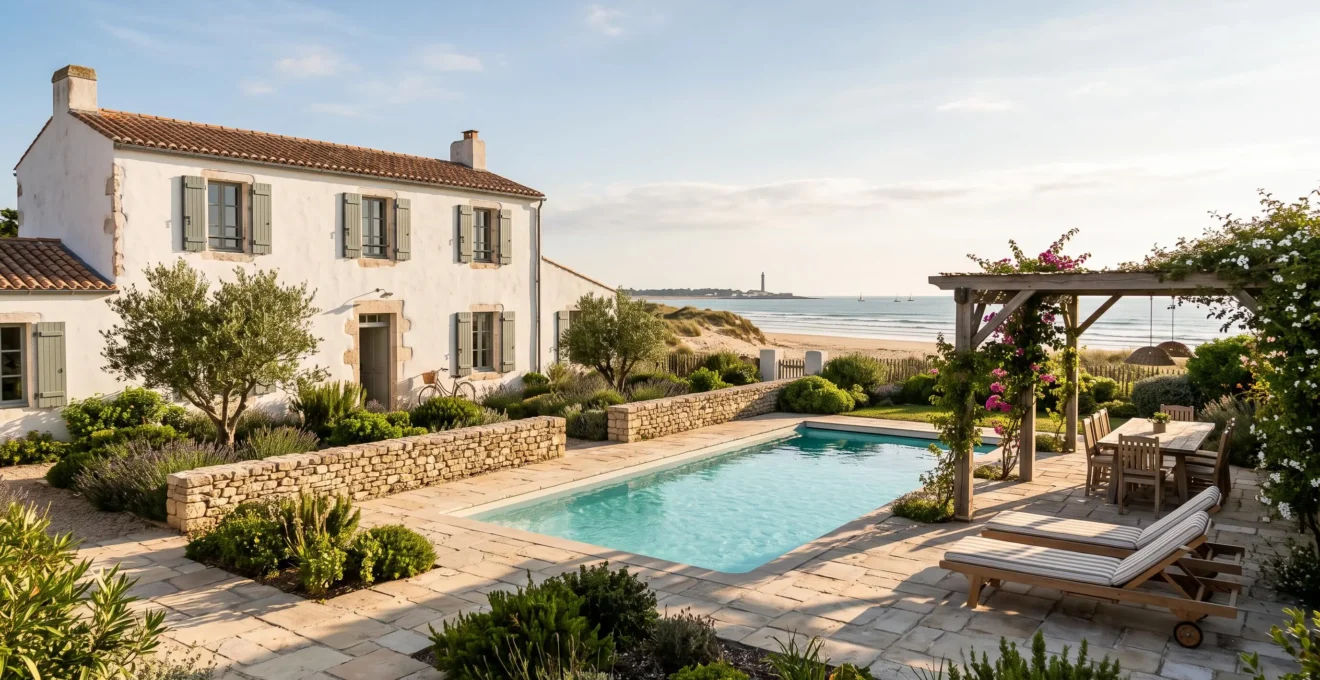
Choosing a luxury villa on the Île de Ré from hundreds of online listings, most accompanied by polished photographs and confident descriptions, means navigating a market where the gap between what is promised and what is delivered can be significant. Without a clear framework for evaluation, even experienced travellers risk booking a property whose actual standard, location or service falls short of expectations—a disappointment only revealed upon arrival.
The island’s popularity as a premium summer destination intensifies the challenge: high demand compresses availability, listings multiply, and distinguishing a genuinely exceptional property from a standard holiday rental presented with flattering imagery becomes harder. This article sets out five concrete, verifiable features that separate luxury villas from ordinary rentals on the Île de Ré, and provides the questions you should ask before committing to a booking.
Why villa quality varies so widely on the Île de Ré
The holiday rental market operates without uniform quality standards. Two properties marketed with similar language—”luxury villa with sea view and heated pool”—can deliver vastly different experiences, because the terms themselves carry no regulated meaning. One villa may sit five minutes’ walk from a sandy beach with unobstructed Atlantic views, meticulously maintained by a local property manager who inspects before every arrival; another may offer a distant glimpse of water from an upstairs window and a pool whose heating proves unreliable, managed remotely with minimal oversight.
The Île de Ré’s seasonal pattern sharpens these inconsistencies. According to data from Destination Île de Ré, the very high season in 2024 concentrated into roughly three weeks from early August, with seasonal rentals up 13 % between April and September 2024 compared to the previous year. This compression of demand into a narrow window means that properties of widely varying quality all find tenants, reducing the immediate market pressure on owners to maintain exacting standards or transparency. When availability is scarce, even listings with vague descriptions or older photographs secure bookings.
Evaluating a property from a distance can make the decision even more challenging. Photos are often carefully chosen to showcase the most appealing features, while descriptions tend to highlight the advantages and leave potential limitations less visible. Expressions such as “near the beach” or “sea view” can also mean very different things depending on the property. A thorough check of the exact location, surroundings, views and amenities is therefore essential before confirming a holiday rental, especially when booking from abroad.
The five criteria that follow provide a method for cutting through ambiguity. Each translates a general expectation—good location, high-quality facilities, reliable service—into specific, verifiable questions that allow you to assess a property’s true standard before booking.
Location and sea access: what should you actually verify?
Location descriptions in villa listings often deploy three phrases that sound similar but describe meaningfully different realities: “sea view,” “close to the beach,” and “direct beach access.” A sea view may mean a partial glimpse of the horizon from a first-floor balcony, visible only when standing; proximity to the beach could refer to a distance requiring a ten-minute drive; direct access typically means the property borders coastal dunes or a beachfront path, allowing you to reach sand within a few minutes on foot. Clarifying which applies to a specific villa—and asking for the walking distance in metres, not generalities—removes a major source of disappointment.
The island’s ten villages differ in character and appeal. According to the official tourism office, Les Portes-en-Ré offers an unspoilt natural setting of wild dunes and pine forest at the island’s western tip, while La Flotte holds classification among France’s Plus Beaux Villages. Saint-Martin-de-Ré, the historic capital, combines architectural heritage with a working harbour and boutique-lined streets; Ars-en-Ré is known for its traditional white-and-green church spire and quieter lanes. Choosing between them depends on whether you prioritise seclusion and nature, vibrant village life, or something between the two. Requesting the precise village name and checking its position on a detailed map prevents assumptions based solely on “Île de Ré” as a destination.

The island’s extensive network of dedicated cycle paths—over 100 kilometres crossing the entire territory—means that even a villa set back from the coast can offer easy, car-free access to beaches, villages and markets, provided it includes secure bicycle storage and is within reasonable cycling distance of the routes. Asking whether bikes are included, how many, and how far the nearest cycle path lies adds another layer of practical evaluation.
Location verification checklist
- Request the exact walking or cycling distance to the nearest beach, in metres or minutes, not generalities.
- Ask whether “sea view” means a full, partial or distant view, and from which rooms or outdoor spaces.
- Confirm the specific village, not just “Île de Ré,” and research its character and amenities independently.
- Check the property’s position relative to the cycle path network if car-free mobility matters to your stay.
How to assess the true standard of a luxury villa
A genuinely high-end villa on the Île de Ré should meet a baseline of space, equipment and condition that justifies premium pricing. At minimum, expect at least four bedrooms with dedicated bathrooms, a private heated swimming pool of sufficient size for family use, a landscaped garden with mature planting and outdoor dining areas, and interiors furnished to a standard comparable to a quality hotel—not simply clean and functional, but thoughtfully designed with comfortable seating, effective lighting, well-equipped kitchens and tasteful décor. Villas that fall short of this baseline, regardless of their photographs, remain standard holiday rentals.
Photographs reveal more than intended when examined critically. Look for signs of recent maintenance: crisp paintwork, modern fittings, outdoor furniture in good condition, pools with clean waterlines. Read descriptions for specific details—construction or renovation dates, brands of appliances, pool dimensions, garden size in square metres—rather than subjective claims. If a listing provides only wide-angle shots or avoids showing bathrooms, kitchens or outdoor spaces in detail, it may be masking limitations.
The most reliable signal of quality, however, is the assurance that someone with local expertise has physically inspected the property shortly before your arrival and verified that it meets stated standards. Specialists such as Travel Paradise specialist in luxury villa rentals build their reputations on rigorous selection processes, with local teams who visit properties, assess condition and equipment against defined criteria, and guarantee that what is advertised matches reality. This professional verification layer—conducted by people who understand both the local market and the expectations of discerning clients—offers far greater confidence than a direct owner’s assurances or an unvetted platform listing.
Ask explicitly who inspects the property and when. A reputable manager or agency will answer clearly and may provide inspection reports, photographs or detailed inventories. Evasive or vague replies should raise concern.
What to ask about property standards: Request the year of last renovation, specific pool dimensions and heating type, the number of bathrooms (not just bedrooms), and whether the property undergoes a professional pre-arrival inspection by a named local manager.
Services and concierge: what separates a rental from an experience?
The difference between renting a property and experiencing a seamless, personalised stay lies in the services wrapped around it. A luxury villa should offer more than keys and a departure date: it should provide a responsive local concierge, guaranteed response times for queries or problems, professional housekeeping throughout your stay (not just on departure), and the ability to arrange tailored services such as a private chef, wine deliveries, restaurant reservations or curated local experiences. These services transform a passive rental into an active hospitality experience, comparable to a high-end hotel but with the privacy and space of a private home.

The presence of a named, contactable local manager or concierge—someone based on the island, available by phone, able to address issues promptly—matters more than any written service list. If the only contact is a distant call centre or an email address with no guaranteed response time, you lack the assurance that problems will be resolved swiftly during your stay. Ask for the name of the person responsible for your villa, their contact details, and their guaranteed maximum response time.
Service levels vary widely. Some properties include daily housekeeping, stocked welcome provisions, pre-arranged childcare or activity bookings as standard; others offer these only at additional cost, or not at all. Clarify exactly what is included in the rental price and what incurs extra charges. A transparent, itemised answer indicates professional management; vagueness or reluctance to specify suggests services may be less comprehensive than implied.
The ability to arrange bespoke experiences—private sailing excursions, guided oyster farm visits, tables at sought-after restaurants—depends on the manager’s local network and experience. A well-connected concierge can secure access and personalisation that independent travellers cannot easily replicate, adding significant intangible value to a stay.
Service and concierge questions to ask
- Who is the named local contact for your villa, and what is their maximum response time?
- Which services are included in the rental rate (housekeeping frequency, welcome provisions, concierge availability) and which cost extra?
- Can the concierge arrange specific requests—private chef, restaurant bookings, activities—and what notice do they require?
- What happens if something in the property fails or requires repair during your stay, and how quickly will it be addressed?
Booking with confidence: your checklist before reserving
The final verification concerns the professionalism and transparency of the booking process itself. A reputable property manager or agency will provide clear terms and conditions, a detailed rental agreement specifying obligations on both sides, transparent cancellation policies, and evidence of appropriate insurance and liability coverage. They should answer questions directly, provide additional photographs or information on request, and allow you to speak with a knowledgeable representative who can discuss the property in detail. Reluctance to provide documentation, vague contract terms, or pressure to book quickly without adequate information are warning signals.
Seasonality on the Île de Ré demands early planning. As the data from Destination Île de Ré show, the highest demand concentrates into a narrow period spanning late July and August, when the island’s most desirable properties secure bookings many months in advance. Waiting until spring to reserve a luxury villa for the summer peak risks finding limited availability or settling for a property that does not meet your standards. Booking six to twelve months ahead for high season allows you to select from the best inventory and secure your preferred dates and location.
Before confirming any reservation, apply this final five-point verification:
- Location and accessConfirm the exact village, the precise distance to the nearest beach (in metres or minutes on foot), and whether “sea view” or “beach access” is clearly defined and documented. Verify the villa’s position relative to the cycle path network if that influences your plans.
- Property standard and inspectionEstablish the baseline equipment (number of bedrooms and bathrooms, pool size and heating, garden area), the date of last renovation, and who conducts pre-arrival inspections. Request recent photographs if those in the listing appear dated.
- Services and conciergeIdentify the named local contact, their response-time guarantee, and which services (housekeeping, provisions, concierge) are included versus additional. Ask for examples of bespoke arrangements they have made for previous guests.
- Contract and transparencyReview the rental agreement for clear terms, cancellation policy, deposit and payment schedule, insurance coverage, and liability provisions. Ensure you understand what happens in the event of a problem with the property during your stay.
- Timing and availabilityBook well in advance—ideally six to twelve months before high season—to secure the best properties. Confirm that your preferred dates are genuinely available and that the booking is guaranteed in writing, not merely held provisionally.
Selecting a luxury villa on the Île de Ré with confidence means shifting focus from what a listing promises to what you can independently verify. By applying these five criteria—location clarity, property standard, service level, professional management and early planning—you transform an uncertain transaction into an informed decision, backed by concrete evidence rather than marketing language. The result is a stay where the villa, its setting and the support around it match your expectations from the first day to the last.