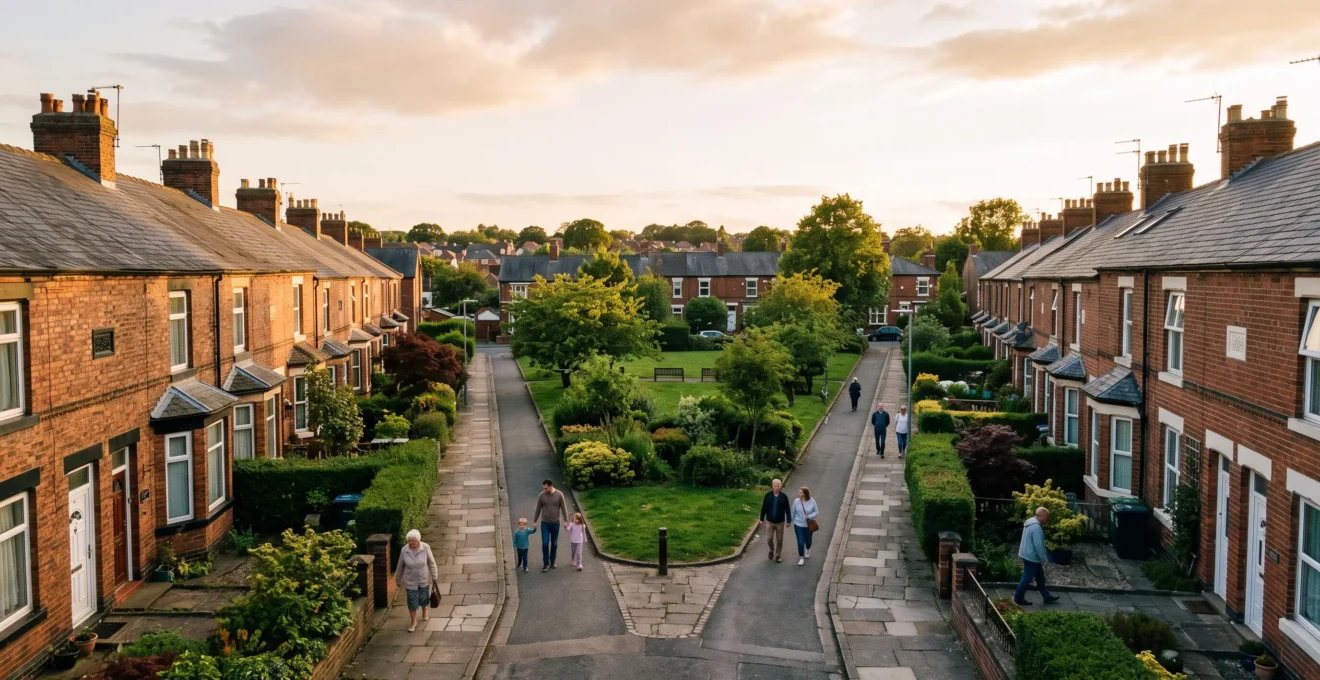
The search for a happy home in the UK often focuses on the wrong things; true residential well-being isn’t about proximity to shops, but about the quality of a neighbourhood’s ‘social infrastructure’.
- Features that create “bumping spaces” for spontaneous interaction, like community gardens and well-placed benches, are more critical than formal amenities.
- A neighbourhood’s happiness profile is defined by its ability to foster belonging through informal social hubs, often called “third places”.
Recommendation: Instead of counting amenities, audit a potential neighbourhood for its capacity to create effortless social connections and a sense of shared identity.
Choosing a place to live is one of life’s biggest decisions. For many UK residents, the process involves a familiar checklist: good transport links, proximity to supermarkets, decent schools, and low crime rates. We scour property sites and focus on the functional aspects of a location, believing these are the cornerstones of a happy life. We measure distances and calculate commute times, but often overlook the single most important factor for long-term well-being: genuine community connection.
The common advice is to look for a park or a local pub, but this is a superficial reading of what makes a community thrive. The real question is not *what* amenities a neighbourhood has, but *how* those amenities function to bring people together. A park can be an empty expanse of grass, and a pub can be a place where no one speaks to each other. The prevailing wisdom often mistakes physical presence for social function. This guide challenges that assumption.
What if the key to daily happiness wasn’t in the big, obvious features, but in the subtle, often invisible ‘social infrastructure’? This article moves beyond the generic checklist to explore the specific, evidence-backed environmental and social features that actively cultivate belonging and reduce social isolation. We will delve into the science and sociology of place, uncovering why some neighbourhoods feel like home while others remain a collection of disconnected houses. We will provide you with the tools to see beyond the estate agent’s brochure and truly understand the social heartbeat of a place before you commit.
This article provides a detailed exploration of the elements that transform a simple location into a thriving community. The following sections break down the key features, psychological factors, and practical steps you can take to find a neighbourhood that truly aligns with your desire for connection and happiness.
Summary: A Guide to Finding True Community Connection in Your Neighbourhood
- The 5 Community Features That Cut Social Isolation in UK Neighbourhoods by 60%
- Why Residents Near Active Community Hubs Feel 3x More Connected to Neighbours
- How to Match Your Social Preferences to Neighbourhood Community Profiles
- When Overly Active Residents’ Associations Create Pressure Rather Than Belonging
- How to Create Community When Your Neighbourhood Has No Organised Activities
- The 6 Environmental Factors That Predict Whether You’ll Love or Leave Your Home
- City Arts and Dining vs Countryside Walks: Which Lifestyle Predicts Happiness
- Which Local Amenities Reduce Weekly Household Admin Time by 5 Hours
The 5 Community Features That Cut Social Isolation in UK Neighbourhoods by 60%
The fight against social isolation begins not with grand programmes, but with the subtle design of our immediate surroundings. True community is built on a foundation of informal, regular, and voluntary interactions. The sociologist Ray Oldenburg identified these crucial locations as “third places”—environments outside the home (first place) and work (second place) where people can gather and connect. He described these informal gathering spaces as the “anchors of community life,” and their presence is a powerful predictor of neighbourhood well-being.
These features are not about expensive facilities, but about creating opportunities for casual encounters. Key examples include:
- Shared gardens and allotments: These offer a common purpose and a reason to be outdoors together, fostering slow, natural conversations.
- Well-placed public benches: Not just any bench, but those positioned to overlook an area of activity, allowing for people-watching and casual greetings.
- Local libraries with seating areas: They provide a quiet, accessible, and non-commercial space for people of all ages to coexist.
- Walkable high streets with small, independent shops: These encourage residents to be out and about on foot, creating “bumping spaces” where neighbours cross paths.
- Dog parks or popular walking routes: Shared interests, like pet ownership, serve as powerful social catalysts.
The absence of this social infrastructure can be deeply damaging. Research highlights a clear link between social isolation and reduced wellbeing, especially for those who spend more time at home. As a study on shared spaces from Housing LIN points out, the absence of daytime footfall can deepen feelings of isolation for residents. Therefore, the most effective community features are those that animate our neighbourhoods with gentle, consistent human presence.
These hands-on, low-cost community spaces are often the most effective. They require a small amount of shared effort, which in itself builds bonds and a sense of collective ownership. When evaluating a neighbourhood, look for these signs of life—the evidence that people have a place to simply *be* together, without an agenda or a cost of entry.
Why Residents Near Active Community Hubs Feel 3x More Connected to Neighbours
While informal “third places” form the bedrock of daily connection, active community hubs serve as the heart of a neighbourhood’s social life. These are dedicated venues, often run by and for local people, that provide a structured-yet-flexible space for activities, services, and events. They are more than just buildings; they are dynamic centres that respond to the community’s needs, whether that’s hosting a parent-and-toddler group, a repair cafe, or a local history exhibition.
The power of these hubs lies in their ability to centralise community energy. A report by Groundwork on UK community hubs in places like Blackpool and Kettering found that while each hub was unique, they all delivered similar positive outcomes, particularly in rebuilding social connections and improving the local environment. Residents living near these hubs feel more connected because the hub provides a reliable, visible anchor for community life. It sends a clear signal that this is a place where people come together and care for their shared home.
The growth of these initiatives across the UK is a testament to their effectiveness. The UK Network of Age-friendly Communities, which champions accessible and supportive local environments, is a powerful force in this area. Investing in neighbourhood-level support is a key priority, recognising that strong social bonds are essential for health and resilience. The scale of this movement is significant and shows a national recognition of the importance of community infrastructure.
A hub’s success depends on its accessibility and the variety of ways people can get involved. It shouldn’t be a closed shop but a welcoming space with multiple entry points. This could range from simply enjoying the community cafe to volunteering or even starting a new project. By offering different levels of engagement, these hubs empower residents to participate at their own pace, building both individual confidence and collective spirit.
How to Match Your Social Preferences to Neighbourhood Community Profiles
Finding a community that fits is like finding a good friend—it requires understanding both yourself and the other party. Every neighbourhood has a unique “social profile,” an unspoken rhythm of how its residents interact. Some are vibrant and event-driven, while others are quiet and private. The key is to diagnose this profile before you move in and see if it aligns with your own social needs and preferences.
Rather than guessing, you can perform a simple “community audit.” This involves observing the neighbourhood not as a collection of properties, but as a living system. Spend time there on a weekday morning and a weekend afternoon. Where do people naturally congregate? Look for the informal social hubs: the busy corner cafe, the queue at the post office, the parents chatting at the school gates, or the local barber shop. These are the places where the community’s pulse can be felt. They are the contact points for wider engagement and reveal where social energy is already flowing.
Your social preference matters. Are you an introvert who thrives on a few deep connections, or an extrovert who needs a steady stream of social events? A neighbourhood with many quiet “third places” like libraries and peaceful parks might suit an introvert, while an area with a bustling market and an active community centre may be better for an extrovert. Moreover, research on community belonging shows that housing stability is a major factor; residents who have lived in an area for 5-10 years report much stronger connections. A transient area may offer novelty, but a stable one is more likely to offer deep roots.
Case Study: Waltham Forest’s 15-Minute Neighbourhood Audit
The London Borough of Waltham Forest provides a real-world template for this kind of audit. As part of its pioneering “15-minute neighbourhood” approach, the council surveyed over 1,200 residents to understand what they felt was important to their local health and happiness. This process of asking residents directly what they value—from green spaces to local shops—is something you can replicate informally by observing and talking to potential neighbours. It turns the abstract idea of “community” into a concrete set of observable features.
Your Community Audit Checklist: How to Read a Neighbourhood’s Social Profile
- Identify interaction points: List all the places where you see people already interacting, from cafes and post offices to school gates and faith centres.
- Observe the energy: Visit at different times. Is the atmosphere bustling and chatty, or calm and reserved? Does this match your energy level?
- Check for “third places”: Are there non-commercial spots where people can simply exist together, like libraries or park benches with good views?
- Assess stability vs. transience: Look at “for sale” signs versus established gardens. Does the area feel settled or constantly in flux?
- Talk to a local: Ask a shopkeeper or someone in a cafe what they like about the area and what the community is like. Their answer will be more revealing than any property listing.
When Overly Active Residents’ Associations Create Pressure Rather Than Belonging
An active residents’ association or a packed calendar of community events can seem like the ultimate sign of a connected neighbourhood. But for newcomers, these can sometimes feel less like an open invitation and more like an exclusive club with unwritten rules. When a community’s social life is dominated by a tight-knit group, it can inadvertently create barriers to belonging for those on the outside.
This phenomenon is known as “gatekeeping,” where an established in-group (consciously or not) controls access to social circles and influence. These groups often have the best intentions—to preserve the character of the neighbourhood or maintain high standards for community events. However, this can manifest as social pressure, cliquishness, or an intimidating environment for new residents who don’t know the unspoken social codes. As community-building expert Charles Vogl notes, this creates a difficult situation for outsiders.
When leaders refuse to name their standards, visitors must guess at the rules.
– Charles Vogl, The Hidden Role of Gatekeepers in Belonging
The social dynamics of gatekeeping are complex. Psychological studies confirm this double-edged sword: six primary studies demonstrated that individuals who exclude others are often perceived as more committed to the group’s values, but also as significantly less likable. This creates a powerful in-group/out-group dynamic that reinforces the clique while alienating potential new members. For someone moving into the area, it can feel like trying to break into a fortress.
This issue has become more pertinent in recent years. Post-pandemic, there has been a noticeable shift in community involvement. For instance, data from the Centre for Ageing Better indicates that volunteering among people aged 50+ has diminished compared to pre-pandemic levels. This can lead to smaller, more burdened groups of volunteers running local associations, potentially making them more protective of their roles and less open to new input. An overly prescriptive or demanding community can create burnout and pressure, which is the very opposite of the supportive environment people seek.
How to Create Community When Your Neighbourhood Has No Organised Activities
What if you find the perfect house in a neighbourhood that seems to have no social pulse? No community hub, no residents’ association, no summer fete. It’s a common scenario, but it’s not a lost cause. In fact, these “blank slate” neighbourhoods can offer the greatest opportunity for building a community from the ground up, tailored to the people who actually live there.
The key is to start small and focus on creating what urbanists call “bumping spaces”—enhancing the physical environment to encourage chance encounters. This doesn’t require a huge budget. It could be as simple as placing a colourful bench in a shared green space, starting a mini plant-swap library on your front wall, or organising a simple, recurring, low-effort gathering. The goal is to create a physical focal point that draws people out of their homes and gives them a reason to pause and interact naturally.
These small, resident-led initiatives are incredibly powerful. The Near Neighbours programme, for example, was established in 2011 to help people in diverse UK neighbourhoods build relationships of trust and work on small projects that improve their local area. This model shows that community life can be sparked by small, coordinated actions, without needing formal top-down organisation. A weekly Saturday morning coffee on a shared green, a monthly litter-pick, or a simple “street play” session for kids can become the anchor rituals that a new community forms around.
The National Lottery Community Fund suggests a three-part strategy for boosting this “pride in place.” First, enhance the environment with bumping spaces. Second, put community venues (even small ones) under community control so they can respond to local needs. Third, and most importantly, provide a variety of participation roles. Not everyone wants to be a leader. By offering small, easy entry points—like simply showing up, bringing biscuits, or spreading the word—you allow people to get involved at their own pace. This builds resilience and slowly revives community spirit from the grassroots level.
The 6 Environmental Factors That Predict Whether You’ll Love or Leave Your Home
Beyond organised activities and social hubs, the very layout of a neighbourhood has a profound psychological impact on our sense of well-being and belonging. Certain environmental factors can make us feel safe, comfortable, and connected, while others can create a persistent sense of unease. Understanding these factors is crucial for predicting whether you will truly feel “at home” in a place.
One of the most powerful concepts in environmental psychology is Prospect-Refuge Theory. First proposed by geographer Jay Appleton, it suggests that humans are instinctively drawn to environments that offer both “prospect” (an unimpeded view of the surroundings) and “refuge” (a place of safety and concealment). A classic example is a hilltop with a wide-open vista, or a cosy seat by a window overlooking a bustling street. This balance satisfies our deep-seated need to see without being seen, creating a feeling of security and control.
Environments that meet such needs will often provide people with the capacity to observe (prospect) without being seen (refuge).
– Jay Appleton, summarised by ArchPsych
This theory has direct implications for neighbourhood design. A home with a front porch (refuge) overlooking a communal green (prospect) is a perfect embodiment of this principle. A park bench tucked under a tree canopy, as shown below, offers the same psychological comfort. Meta-analyses of urban design studies have confirmed the importance of prospect, reinforcing the value of open views and clear sightlines in making urban spaces feel safe and welcoming. When choosing a home, consider these six key environmental factors influenced by this theory:
- Clear Sightlines: Can you see far down the street? Open views reduce the fear of the unknown.
- Protected Vantage Points: Does the home or garden offer a sheltered spot from which to watch the world go by?
- A Sense of Enclosure: Do streets feel like safe, contained “outdoor rooms,” or are they wide, exposed, and dominated by traffic?
- Legibility: Is the neighbourhood easy to navigate, or is it a confusing maze that creates anxiety?
- Access to Nature: Even small pockets of green provide a restorative refuge from the hard surfaces of urban life.
- Human Scale: Are buildings and streets designed for people on foot, or do they dwarf pedestrians and prioritise cars?
These elements are not just aesthetic; they are fundamental to our psychological comfort. A neighbourhood that successfully balances prospect and refuge is one that feels inherently safe and inviting, encouraging residents to spend more time outdoors and, in turn, increasing the chances of social interaction.
City Arts and Dining vs Countryside Walks: Which Lifestyle Predicts Happiness
The age-old debate of city versus country living often frames happiness as a choice between two distinct lifestyles: the cultural buzz of urban arts and dining versus the tranquil beauty of countryside walks. However, research into community well-being suggests this is a false dichotomy. Happiness is less about the *type* of amenities available and more about their *proximity* and *accessibility*.
The most powerful predictor of neighbourhood happiness is the “20-minute neighbourhood” principle. This is a model for urban and rural planning where residents can meet most of their daily needs within a 20-minute walk or cycle from their home. This includes not just shops and services, but also employment, education, healthcare, and, crucially, leisure and culture. Whether your preferred “third place” is a theatre, a hiking trail, a restaurant, or a library is secondary. The critical factor is whether you can access it easily and without relying on a car.
When neighbourhoods are designed this way, the benefits are transformative and cut across the city/country divide. As the UK’s Town and Country Planning Association (TCPA) explains, the positive effects create a virtuous cycle that enhances overall well-being. They note that in well-designed 20-minute neighbourhoods, a number of positive outcomes can be observed.
The Benefits of Walkable Neighbourhoods
According to the TCPA’s research on the 20-minute neighbourhood concept, when daily needs are within easy reach, “People become more active, improving their mental and physical health; traffic is reduced, and air quality improved; local shops and businesses thrive; and people see more of their neighbours, strengthening community bonds.” This demonstrates that the structure of a place is more important than its specific urban or rural label. A walkable village with a pub, shop, and post office can deliver the same happiness benefits as a dense city district with cafes, galleries, and a park.
Therefore, the question to ask when choosing a location is not “Do I prefer the city or the country?” but “Does this location allow me to live a significant portion of my life locally?” Can you walk to a place for coffee, meet a friend for a drink, or get to a park without starting your car engine? A lifestyle built on local, walkable access is what predicts happiness, as it naturally integrates physical activity, social connection, and support for the local economy into your daily routine.
Key Takeaways
- True community is built in “third places” and “bumping spaces” that foster informal, spontaneous interactions.
- The structure of a neighbourhood (like the 20-minute principle) is more important for happiness than a simple city vs. country choice.
- You can proactively audit a neighbourhood’s social profile by observing where people naturally gather and interact before you decide to live there.
Which Local Amenities Reduce Weekly Household Admin Time by 5 Hours
While social connection is the soul of a happy neighbourhood, practical convenience is its backbone. The constant drain of “life admin”—weekly shops, school runs, post office trips, and accessing healthcare—can significantly eat into our free time and add a layer of persistent, low-level stress to our lives. A well-designed neighbourhood, however, can give you back hours every week by clustering these essential services within a short, walkable radius.
This is the practical magic of the 15 or 20-minute neighbourhood concept. When amenities are thoughtfully integrated, they do more than just exist; they function as a system that reduces the friction of daily life. For example, concrete redevelopment projects in Manchester and Leeds are creating ‘people areas’ that prioritise walking and cycling. By making it easier for residents to move around their local area without a car, these initiatives directly reduce time lost to traffic, searching for parking, and car-dependent errands. This frees up time that can be reinvested into family, hobbies, or community participation.
To assess a neighbourhood’s time-saving potential, it’s useful to think of amenities as fulfilling six core life functions. According to a framework from Sustainable Wales, every truly local neighbourhood should provide for:
- Living: Quality housing that is well-integrated with other services.
- Working: Access to employment or co-working spaces locally.
- Supplying: A cluster of shops for daily and weekly needs (grocer, pharmacy, etc.).
- Caring: Nearby healthcare facilities (GP, dentist) and childcare.
- Learning: Schools and libraries within easy reach.
- Enjoying: Leisure, culture, and social spaces integrated into the same local area.
When a neighbourhood delivers on all six of these functions, the time savings are exponential. A single trip can combine a school drop-off, a visit to the pharmacist, and grabbing groceries, all on foot. This not only saves hours but also reduces the mental load of planning complex, car-dependent journeys. It transforms errands from a stressful chore into a pleasant, and potentially social, part of the day.
To find a neighbourhood that delivers both practical convenience and deep social connection, start by applying this new lens to your property search. Look beyond the four walls of a house and assess the ‘social infrastructure’ and ‘walkability’ of the area. This shift in perspective is the first and most crucial step toward finding a place where you will not just live, but truly thrive.