The secret to long-term happiness in a property isn’t found in its square footage or kitchen fixtures; it’s predicted by the invisible environment that surrounds it.
- Chronic noise, poor natural light, and a weak social fabric are the top reasons people regret a move, often costing thousands in unforeseen value loss and relocation expenses.
- A structured “Environmental Audit” focusing on sensory and social factors provides a far more accurate prediction of future satisfaction than a standard viewing checklist.
Recommendation: Before making any offer, shift your focus from viewing the property as a static object to auditing it as a dynamic living environment you will inhabit for at least five years.
The decision to move is one of life’s most significant financial and emotional investments. For UK residents planning to stay put for five years or more, the stakes are even higher. The sheer cost and stress of relocation mean getting it right the first time is not just a desire, but a financial and mental health imperative. We often approach this decision armed with checklists: Ofsted ratings, crime statistics, number of bedrooms, and proximity to transport links. We meticulously inspect the building for damp and check the boiler’s age.
Yet, years later, a creeping dissatisfaction can emerge. The “perfect” house no longer feels like a home. Why? Because these standard checklists, while useful, miss the most critical predictors of long-term contentment. They focus on the tangible shell of the property, ignoring the invisible, dynamic environment that truly shapes our daily quality of life—the constant hum of traffic, the way light moves through a room in winter, or the subtle social connections (or lack thereof) on your street.
But what if the true key to lasting residential happiness wasn’t about finding the perfect house, but about mastering the art of auditing its environment? This guide moves beyond the platitudes. It provides a new framework for assessing a potential home, focusing on the sensory, social, and lifestyle factors that determine whether you’ll thrive in a space for the long term or find yourself scrolling through property sites again in a few years. We will dissect the elements that create a sanctuary, quantify the real cost of a poor environment, and equip you with the tools to see, hear, and feel a property’s true potential.
This article will guide you through a comprehensive environmental audit for your potential new home. We will explore the crucial factors that predict long-term satisfaction, from the quantifiable impact of noise to the subtle nuances of community life, empowering you to make a decision that supports your well-being for years to come.
Summary: A guide to auditing the hidden environmental factors for long-term home satisfaction
- The 6 Environmental Factors That Predict Whether You’ll Love or Leave Your Home
- Why Traffic Noise Reduces Property Value by £30,000 in Identical Homes
- How to Test Natural Light Levels When Viewing Properties in November
- The Quiet Sunday Viewing That Hid Friday Night Chaos and Parking Nightmares
- How to Transform a Noisy, Dark Rental Into a Peaceful Sanctuary for Under £400
- The 5 Community Features That Cut Social Isolation in UK Neighbourhoods by 60%
- City Arts and Dining vs Countryside Walks: Which Lifestyle Predicts Happiness
- How to Weigh Lifestyle Quality Against Property Size and Commute Length
The 6 Environmental Factors That Predict Whether You’ll Love or Leave Your Home
When we assess a property, we’re trained to see its features: the number of rooms, the garden’s size, the kitchen’s age. However, long-term satisfaction is rarely determined by these static elements. Instead, it’s governed by the dynamic, often invisible, environmental factors that shape your daily experience. Committing to a home for over five years requires a deeper investigation—a full environmental audit. This process moves beyond a simple viewing and into a holistic analysis of how the space will interact with your life, day in and day out. Thinking like a residential quality consultant means evaluating the property’s ‘sensory signature’ and its ‘social fabric’.
A comprehensive environmental audit focuses on six key areas that have the greatest impact on well-being and are the most common culprits behind a ‘lifestyle-property mismatch’:
- Acoustic Environment: The type, volume, and consistency of noise, from traffic and neighbours to local wildlife.
- Light Quality: The quantity, quality, and seasonal path of natural light throughout the property.
- Air Quality & Green Space: Proximity to pollution sources versus access to parks, woods, and clean air.
- Neighbourhood Rhythm: The flow of people and traffic throughout the day and week, including parking pressure and social activity.
- Community Fabric: The presence and accessibility of ‘third places’ (cafes, pubs, libraries) and the general sense of social connection.
- Lifestyle Alignment: How well the environment supports your actual hobbies, social life, and commuting reality, not just an idealized version.
These factors are not just ‘nice-to-haves’; they are fundamental to your ability to relax, recharge, and feel at home. Ignoring them means you’re only seeing half the picture, risking a costly and emotionally draining relocation when the reality of the environment sets in.
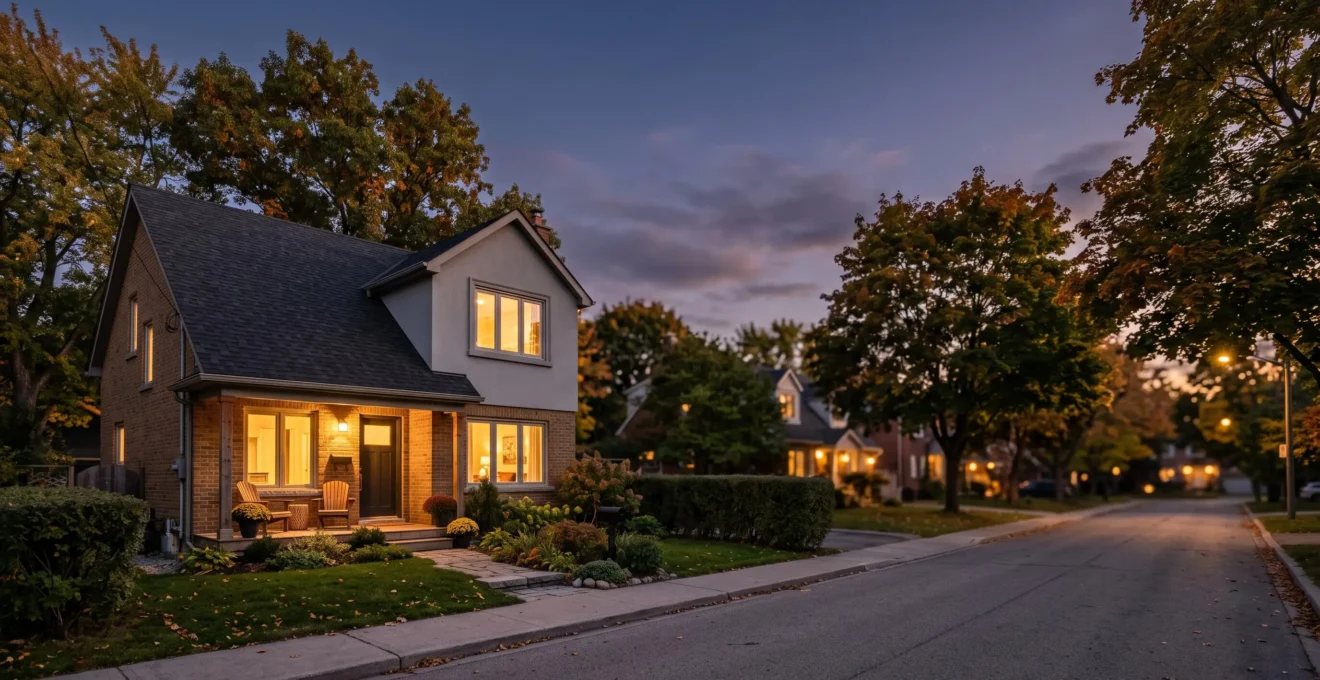
This wide view of a neighbourhood at dusk illustrates the complex layers we must consider. Each light in a window represents a life being shaped by these invisible forces.
By consciously auditing these six areas, you shift from a passive buyer to a proactive investigator of your own future happiness. The following sections will provide the tools to assess each of these factors, ensuring your next home is one you’ll love for many years to come.
Why Traffic Noise Reduces Property Value by £30,000 in Identical Homes
Of all the environmental factors, noise is the most invasive and has the most direct, quantifiable impact on both your well-being and your financial investment. It’s not merely an annoyance; chronic exposure to unwanted sound, particularly traffic noise, is linked to stress, sleep disruption, and decreased cognitive function. The market recognizes this implicitly, creating a tangible ‘peace premium’ for quieter homes. While a seller might highlight proximity to major roads as a convenience, your environmental audit must price in the significant downside.
The financial penalty for noise is not hypothetical. A recent analysis from House Buyer Bureau found that UK homes near motorways lose over £27,130 in value on average compared to identical properties in quieter locations. This figure can climb dramatically in urban centres or areas where tranquility is a key selling point. This financial impact is driven by a simple market reality, as one expert from the analysis noted:
Whether it’s constant traffic outside the front door, trains passing throughout the day or aircraft overhead every few minutes, excessive noise immediately narrows the pool of buyers willing to consider a property.
– Hodgkinson, House Buyer Bureau analysis, The Intermediary
This phenomenon is not unique to the UK. It demonstrates a universal principle of residential value. The negative correlation between noise levels and property prices is a consistent finding across international markets.
Case Study: The Quantifiable Cost of Noise
An Australian study analysed noise pollution across Victoria from busy roads, railways and air traffic against nearby property sale prices over a five-month period. It found that an average decrease in property value of 6% was seen for every 10 dBA increase in road noise. Aircraft noise caused an even steeper 6-9% decline per 10 dBA increase, illustrating that the ‘peace premium’ is a globally recognised market force.
Therefore, when you view a property, you are not just buying the bricks and mortar; you are buying its ‘sensory signature’. A home with a disruptive acoustic profile comes with a hidden liability—one that will affect your daily peace and your ability to sell in the future. Don’t let a lower asking price blind you to the true cost of noise.
How to Test Natural Light Levels When Viewing Properties in November
Natural light is a powerful, non-negotiable component of a happy home. It affects our mood, regulates our sleep cycles, and can make a small space feel open and welcoming. Yet, it’s one of the most deceptive elements during a property viewing. A south-facing living room that feels gloriously sunny on a June afternoon can become a disappointingly gloomy cave by the time November’s low sun rolls around. Committing to a home for 5+ years means you must understand its light quality across all seasons, not just on the day you visit.
Viewing a property in the darker months, while seemingly a disadvantage, is actually a golden opportunity. If a home feels bright and airy in November, you can be confident it will be a wonderful space year-round. To conduct a proper light audit, you must think like an architect. Note the orientation of the main rooms. Check the size and condition of the windows. Look for external obstructions—tall trees or neighbouring buildings—that could cast long shadows in winter. The goal is to assess not just the presence of light, but its quality, direction, and duration throughout the day and year.
This close-up shows the tangible quality of light—its warmth, the textures it reveals, and the atmosphere it creates. This is what you are auditing.
In the past, this required guesswork and multiple visits. Today, technology allows for a precise, year-round analysis before you even make an offer. Using online sunlight and shadow simulation tools, you can project the exact path of the sun over the property on any day of the year. This digital-first approach removes all ambiguity, as one homebuyer’s experience confirms:
We were considering building a new home, and the sunlight simulation stopped us from buying a lot that was in a very dark place, where we would have lost over 2 hours of possible sunlight every day; instead we found and bought a house with ample sunlight after projecting the sunlight in both locations year-round.
– Prospective Buyer, Shadowmap
A proper light audit is one of the most powerful actions you can take to predict your long-term happiness in a home. The following checklist provides a structured way to combine physical observation with digital analysis for a complete picture.
Your Year-Round Sunlight Audit Checklist
- Initial On-Site Assessment: During the viewing, use a compass app on your phone to confirm the property’s orientation. Note which rooms face south (for winter sun) and which face north (for cooler, more diffuse light).
- Digital Simulation: Enter the property’s address into an online sunlight mapping tool. Run a simulation for the summer solstice (June 21st) and the winter solstice (December 21st) to see the extremes of the sun’s path.
- Day-Long Analysis: In the simulation, scrub through the timeline for a typical winter day (e.g., 9 AM, 12 PM, 3 PM) to identify which rooms receive direct light and for how long. Pay close attention to living areas and home offices.
- Comparative Analysis: If you are considering multiple properties, run the same simulations for each. Compare the total “sun hours” for key rooms to make an objective, data-driven decision.
- Identify “Light Oases” and “Dark Zones”: Use the audit to plan your future life. Identify the sunniest spot for a morning coffee nook or the room that will need better artificial lighting for use as a winter workspace.
The Quiet Sunday Viewing That Hid Friday Night Chaos and Parking Nightmares
One of the most common and costly mistakes in the home-buying process is falling for the ‘Sunday Viewing Trap’. You visit a property on a peaceful weekend afternoon. The street is quiet, parking is ample, and the gentle birdsong from the nearby park seals the deal. You move in, only to discover that from Monday to Friday, the road is a rat-run for commuters, and by 7 PM every weeknight, every last parking space has vanished. The “peaceful” street becomes a source of daily stress, and the park’s proximity means it’s the neighbourhood’s go-to spot for loud parties every Friday night.
This scenario highlights a critical flaw in the standard viewing process: it offers only a single, static snapshot of a dynamic environment. A neighbourhood has a rhythm and a pulse that changes dramatically not just between day and night, but between weekdays and weekends. A true environmental audit requires you to understand the full 24/7, seven-day-a-week character of a location. Relying on a single, curated viewing experience is like reading one page of a book and assuming you know the entire story.
To avoid this trap, you must become a neighbourhood detective. Your mission is to uncover the reality of the location beyond the estate agent’s schedule. This doesn’t have to be an onerous process. Strategic, targeted visits can reveal more in 30 minutes than a dozen formal viewings. Drive by during the morning rush hour on a Tuesday. Is the street you’re considering used as a shortcut? How long is the queue of traffic at the main junction? Return at 8 PM on a weekday evening. Where would you park if you came home late from work? Are the spaces taken by residents, or by patrons of the nearby pub? A quick walk around the block on a Friday or Saturday night will tell you everything you need to know about the local nightlife and social atmosphere.
These informal ‘stakeouts’ are not about being paranoid; they are about being prudent. You are gathering crucial data on the ‘neighbourhood rhythm’. This information is invaluable and will never appear on a property listing. The difference between a home that is a sanctuary and one that is a source of constant frustration often lies in these temporal details. A five-minute traffic jam every morning or a twenty-minute search for parking every night is a small friction that, when repeated for years, grinds down your quality of life.
How to Transform a Noisy, Dark Rental Into a Peaceful Sanctuary for Under £400
What if you’re not in a position to buy, or have already committed to a property with a less-than-ideal environment? For many renters or new homeowners on a tight budget, the discovery of a noisy road or a gloomy room can lead to a sense of helplessness. However, you often have more control over your immediate environment than you think. While you can’t move the building or change the road layout, you can make significant improvements to your ‘sensory signature’ with targeted, cost-effective interventions, often for less than £400.
The strategy is one of absorption and reflection. To combat noise, you need to add soft, sound-absorbing materials. To combat darkness, you need to maximize the reflection and quality of the light you do have. This is not about major renovations, but about clever interior design choices that are often temporary and landlord-friendly. It’s about reclaiming your space and turning it into a genuine sanctuary, regardless of the external conditions.
To tackle noise: The primary goal is to stop sound waves from bouncing off hard surfaces (walls, windows, wooden floors).
- Heavy, Lined Curtains (£100-£150): This is your single most effective investment. Thermal or blackout curtains with a thick lining provide a formidable barrier against both noise and light leakage from windows, which are the main culprits for sound transmission.
- Large, Thick Rugs (£80-£120): If you have wooden or laminate floors, a large rug in the main living area or bedroom will do wonders for absorbing ambient noise from both outside and within the home. The thicker, the better.
- Soft Furnishings & Wall Hangings (£50): Think plush cushions, throws, and even fabric wall art or tapestries. Every soft surface you add helps to deaden sound and create a cosier, quieter atmosphere.
To tackle darkness: The aim is to bounce what little natural light you have around the room and supplement it with high-quality artificial light.
- Strategic Mirrors (£50-£80): A large, simple mirror placed on the wall opposite your main window is the oldest trick in the book for a reason. It can dramatically increase the feeling of light and space for a minimal cost.
- Layered Lighting (£70-£100): Do not rely on a single, harsh ceiling light. Invest in a combination of floor lamps and table lamps to create pools of warm light. Use “warm white” (around 2700K) bulbs to create a cosy, inviting glow in the evenings, which counteracts the gloom.
- Light-Coloured Decor: While not a direct cost, when choosing rugs or throws for soundproofing, opt for lighter colours which will help reflect light rather than absorb it.
By combining these strategies, you can easily spend under £400 and fundamentally change the experience of living in your space. These changes buffer you from the negative aspects of the external environment, allowing you to create a peaceful and restorative home base, proving that a limited budget doesn’t have to mean a compromised quality of life.
The 5 Community Features That Cut Social Isolation in UK Neighbourhoods by 60%
A home is more than just the four walls you live in; its value is deeply intertwined with the ‘social fabric’ of the surrounding neighbourhood. You can have the most beautiful house on the street, but if you feel disconnected and isolated, your overall well-being will suffer. This is not a trivial concern; a major Imperial College London study found that 1 in 6 adults in England report persistent loneliness. A key predictor of—and antidote to—this is the physical layout and amenities of our immediate environment.
A neighbourhood with a strong social fabric is one that facilitates casual, spontaneous interactions and provides reasons for people to leave their homes and connect. These are not grand, expensive infrastructure projects, but small, thoughtful features that collectively create a sense of belonging and community. When conducting your environmental audit, you should actively look for the presence of these features, as they are strong indicators of a neighbourhood’s long-term social health.
Based on urban planning research and community studies, five key features consistently emerge as powerful tools against social isolation:
- Walkable ‘Third Places’: These are destinations that are not home (the first place) or work (the second place). A great local pub, a friendly coffee shop, a library, or a community centre within a 10-minute walk provides a neutral, accessible space for residents to meet. Their presence is a primary catalyst for community interaction.
- Well-Maintained Green Spaces with Seating: A park is good; a park with benches, a playground, or a designated dog-run is exponentially better. These amenities encourage people to linger, watch the world go by, and engage in conversation, transforming a green space from a corridor into a destination.
- A Thriving High Street or Local Shops: The ability to walk to a local baker, butcher, or small grocery store creates daily opportunities for brief, friendly interactions with both shopkeepers and neighbours. It weaves the community together through shared errands and familiar faces.
- Active Community Hubs: Look for a village hall, community centre, or even a church with a busy notice board. The presence of clubs, classes (like yoga or book clubs), and local events is a sign of an engaged and active population.
- ‘Human-Scale’ Design: This refers to features like front gardens or porches that are close to the pavement, lower fences, and a layout that prioritizes pedestrians over cars. These design choices make it easier to say hello to a neighbour, fostering a sense of passive, everyday connection.
The presence of three or more of these features in a neighbourhood dramatically increases the likelihood of social connection and significantly reduces feelings of isolation. When choosing a home for the long term, don’t just look at the property; look for the ecosystem of community that surrounds it.
City Arts and Dining vs Countryside Walks: Which Lifestyle Predicts Happiness
The age-old debate of city versus country living often frames it as a simple binary choice: the cultural vibrancy and convenience of urban life against the peace and space of a rural setting. However, when it comes to long-term psychological satisfaction, the answer is far more nuanced. The key to happiness isn’t about choosing one over the other, but about avoiding a ‘lifestyle-property mismatch’—a situation where your home’s location actively works against the life you want to live.
Research suggests that neither extreme necessarily holds the monopoly on happiness. While some studies point to higher life satisfaction in the countryside, others highlight the benefits of urban access. For instance, a 2023 Statistics Canada survey found that 59% of rural residents reported high life satisfaction compared to 49% of urban dwellers, suggesting a potential ‘peace premium’ in less dense areas. However, this doesn’t account for those who thrive on the energy and opportunities of a city.
This image perfectly captures the decision-making crossroads many people face: the choice between two fundamentally different lifestyles, each with its own promise of happiness.
Interestingly, the most compelling evidence suggests that the happiest place might not be in the heart of the city or the depths of the country, but somewhere in between. A groundbreaking study from the University of Amsterdam offered a more refined perspective on the geography of well-being. As reported by HealthDay, the lead author’s conclusion was clear:
Areas near cities but beyond their boundaries… show the highest and most equal levels of psychological satisfaction.
– Adam Finnemann, University of Amsterdam study, published in Science Advances
This points to the ‘sweet spot’ of suburban or ‘edge-of-city’ living, where residents can access the economic and cultural benefits of the city while enjoying more space, greenery, and a stronger sense of local community. The ultimate lesson is one of self-awareness. The right choice is deeply personal. An honest environmental audit requires you to ignore trends and prestige and ask a simple question: Does this location support the daily activities that genuinely bring me joy and peace? Is it a five-minute walk to a forest trail or a five-minute cycle to a theatre? Your answer will reveal more about your future happiness than any property brochure.
Key Takeaways
- True home satisfaction is determined by auditing the invisible environment (noise, light, community) not just the physical property.
- A property’s ‘sensory signature’ has a direct, quantifiable impact on its financial value and your daily well-being.
- Conducting viewings at different times of the day and week is non-negotiable to understand a neighbourhood’s true rhythm and avoid costly surprises.
How to Weigh Lifestyle Quality Against Property Size and Commute Length
The final, and often most difficult, part of the decision-making process involves balancing the three-way trade-off that defines modern home-buying: lifestyle, property size, and commute length. It’s the classic conundrum: you can have a large house with a garden, but it comes with a 90-minute commute. Or you can have a 20-minute walk to work, but live in a small flat. Finding the right balance is the cornerstone of long-term residential satisfaction.
The common mistake is to overvalue tangible assets (square footage, number of bedrooms) and undervalue the intangible but relentless cost of a long commute. A spare bedroom is used occasionally; a commute is a tax on your time, energy, and well-being paid twice a day, five days a week. The negative impact of this daily grind is well-documented.
The Hidden Tax of Commuting
A landmark 2008 study analysing the subjective wellbeing of commuters in Germany found that people with long journeys to and from work are systematically worse off and report significantly lower subjective well-being. The research concluded that the extra time spent commuting is not fully compensated for by a better job or a bigger house. The daily stress and lost personal time simply outweigh the perceived benefits, a phenomenon researchers called the ‘commuting paradox’.
So, how do you make this trade-off consciously? First, quantify your commute. Research suggests the ‘ideal’ commute time for maximizing happiness is just 16 minutes. While this may be an unrealistic goal for many, it serves as a powerful anchor point. Every minute over this is a direct cost to your quality of life. Calculate the total weekly time lost to commuting for each property you consider. Four hours a week? Ten? Twenty? What could you do with that time?
Second, conduct an honest audit of your lifestyle needs versus wants. Do you need a garden for your children and dog to play in, or do you want one that you’ll only use a few times a year? Could a smaller property next to a large public park serve your needs better and cut your commute in half? This isn’t about compromise for its own sake, but about smart optimization. The goal is to choose the option that maximizes your access to the things that truly support your well-being, and minimises the daily frictions that drain it. Often, this means choosing a slightly smaller property in a location with a better lifestyle fit and a shorter commute.
Ultimately, choosing a home for the next 5, 10, or 20 years is an investment in your quality of life. By moving beyond a simple checklist and conducting a thorough environmental audit, you empower yourself to make a choice that aligns with your long-term happiness, not just your short-term needs. To apply these principles effectively, the next logical step is to begin building your own environmental audit for the areas you are considering.